Beyond the Street: Telraam Goes Live at France's Biggest Festivals
How Oktoway is using a single Telraam sensor, deployed in concentric rings from approach road to festival gate, to monitor visitor flow in near real-time

Key information
- Sensor and data hosting
- Custom development (sensor, dashboard, API, ...)
- Footfall monitoring
Each of these stages calls for a different kind of data: high-volume motorized traffic further out, mixed car and pedestrian flow around the parking areas, and pure pedestrian counts near the gates.
Oktoway, a French company building dashboards for festival security, safety and mobility monitoring, needed a way to monitor all three, at different distances from the site, with different traffic mixes, without deploying a different sensor for each. To power it, they turned to Telraam.
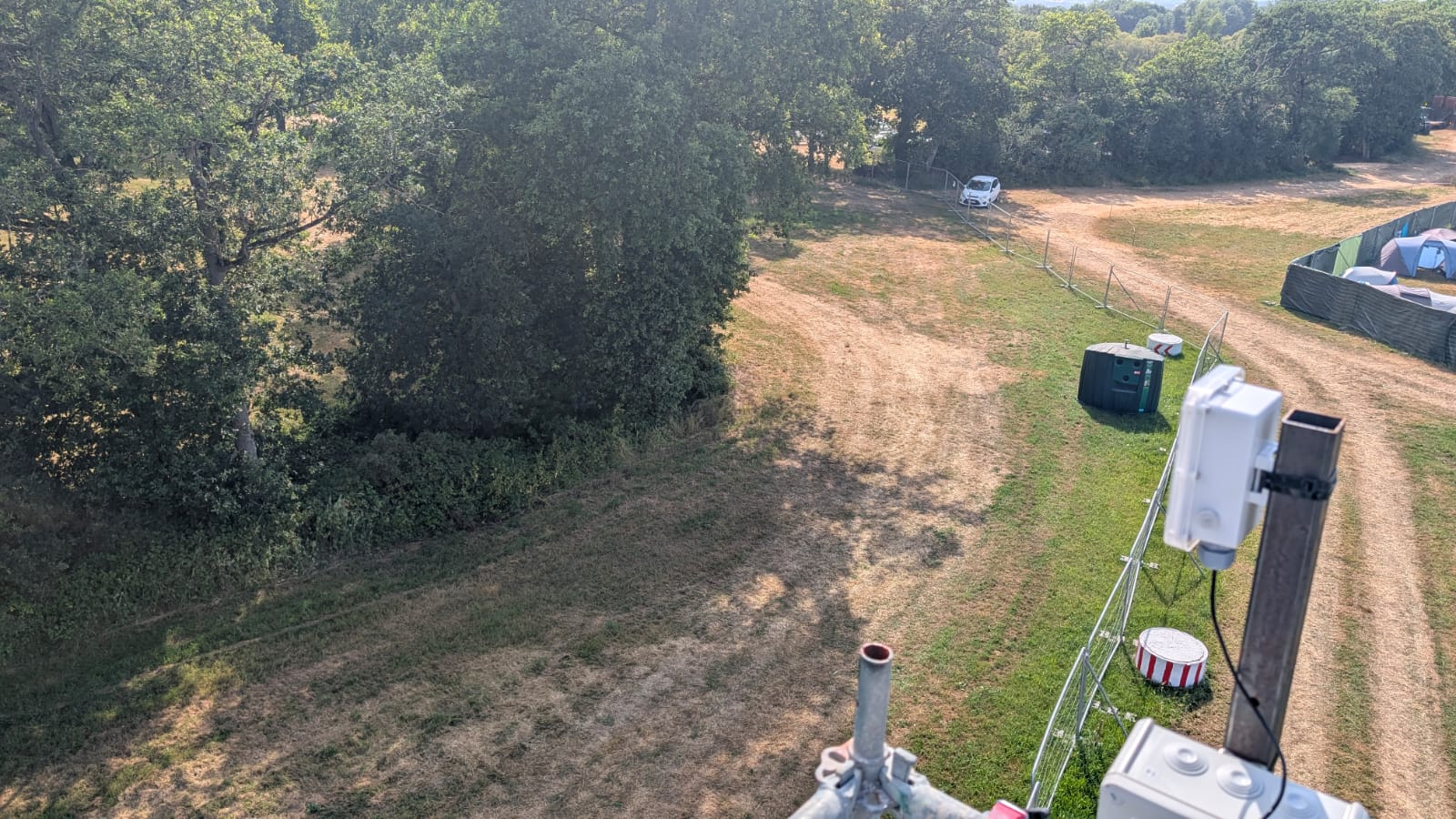
Oktoway's monitoring strategy works like a set of concentric circles around each festival site, each ring with its own traffic mix and its own data need.
Outer ring, the approach roads. On the departmental and national roads leading toward the perimeter, 15-20 minutes out, a handful of sensors track high-volume motorized traffic to catch early signs of congestion before it builds. Here, raw counts alone aren't quite enough: what matters is knowing whether today's traffic is running ahead of what that road normally sees. Telraam's API includes a ready-made comparison against typical traffic patterns for that location, a built-in piece of data analysis Oktoway can call directly rather than having to build the baseline themselves, giving them an early, calibrated signal of unusual build-up well before it reaches the festival gates.
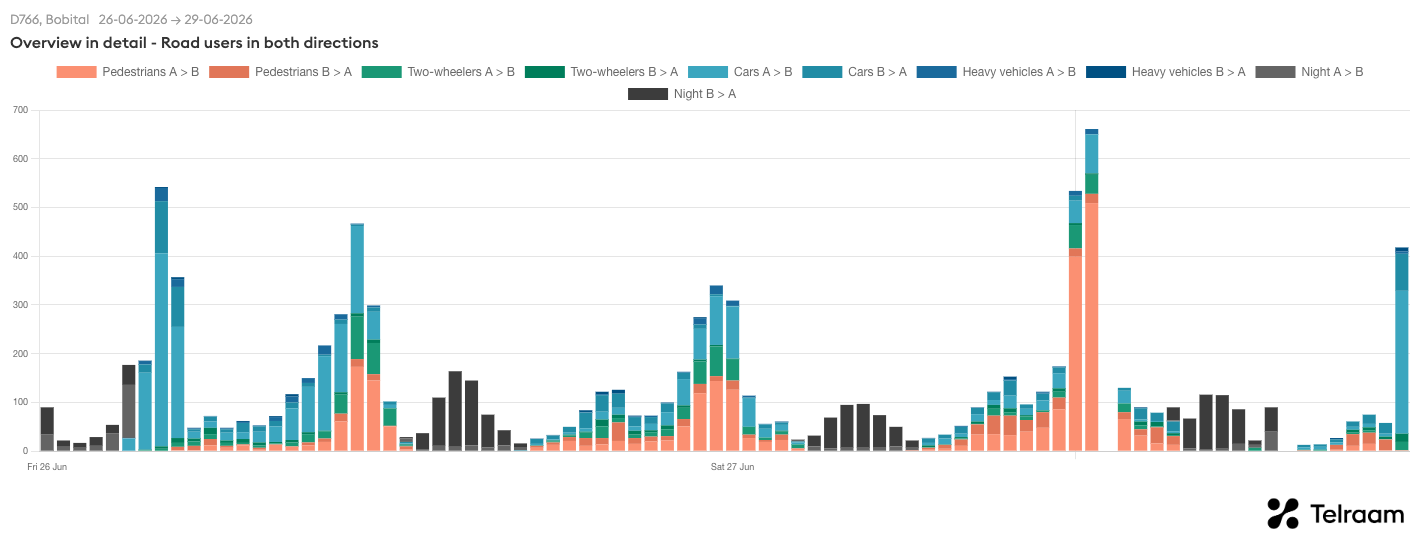
Middle ring, the parking on-ramps. Here, the same sensor type needs to do double duty at a single location: counting cars flowing into the lot to track capacity and peak arrival hours, while simultaneously counting the pedestrians flowing back out of it as visitors park and walk on toward the site.
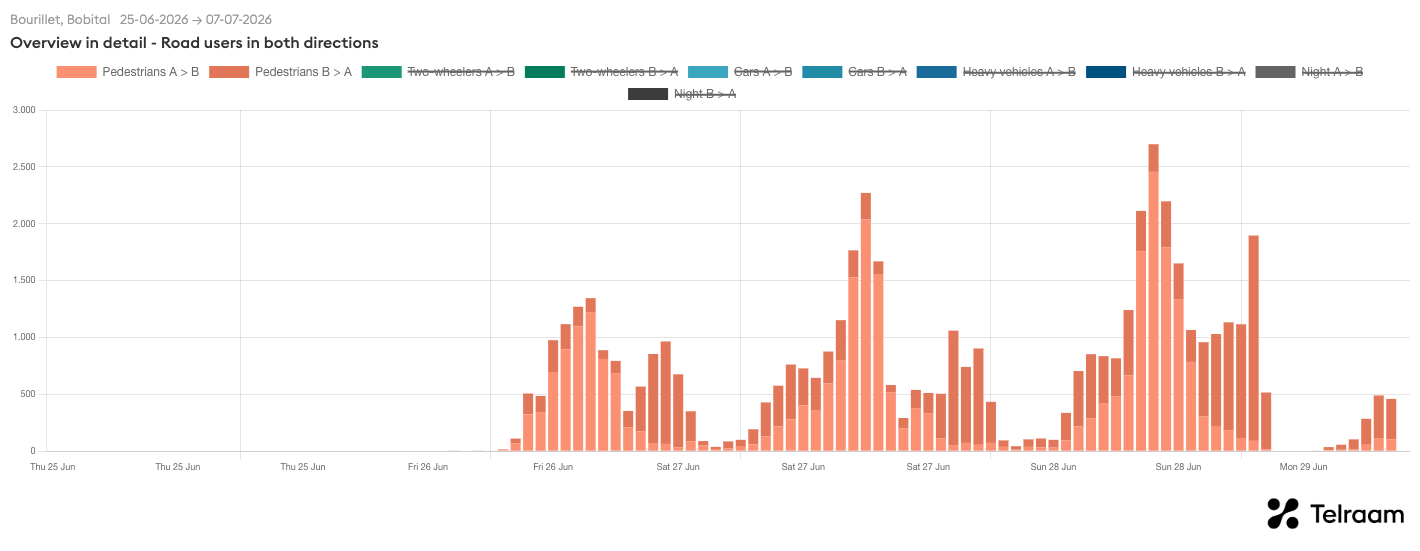
Inner ring, the pedestrian routes. Right along the routes to the entrance, and at the entrance and exit themselves, only active modes matter. Motorized traffic no longer factors in at all, so the sensor's job shifts entirely to isolating and counting pedestrian and cyclist volumes cleanly, giving a direct read on visitor numbers arriving and leaving the site.
Handling three rings this different, one purely motorized, one mixed, one purely active modes, with three different sensor types would have meant three separate systems to deploy, calibrate and integrate. Oktoway needed one sensor capable of adapting to all three and still producing a single, universal data format their dashboard could ingest via API, regardless of which ring it sat in. On top of that, a festival site is a temporary, outdoor, unsupervised environment: the sensor also had to be compact and unobtrusive enough to draw little attention (and little risk of vandalism), and self-sufficient on power, since running mains cable out to a roadside or a parking on-ramp for a few days was never going to be practical. That combination, one universal sensor, easy to deploy, low power, no mains connection needed, is what led Oktoway to Telraam.
From sensor placement strategy to a live data feed
Telraam supplied 10 S2 Outdoor sensors, the same device deployed across all three rings, on national roads, at parking on-ramps, and along pedestrian routes, each producing data in the same universal format regardless of the traffic mix it was watching. The sensors were also configured on a 1-minute data subscription and pushed counts via API straight into Oktoway's dashboard, making Oktoway one of the first clients to run Telraam sensors at this frequency rather than the standard 15-minute interval. Ahead of deployment, our teams worked through multiple planning calls with Oktoway to define the optimal placement for each zone, weighing the trade-offs between coverage and detection accuracy given what each location needed to isolate: motorized traffic, mixed flow, or active modes only. The sensor's low power consumption and compact, discreet footprint meant Oktoway's own team could install it on-site running purely off their own small battery packs, no mains connection needed, keeping every location fully autonomous for the duration of the festival.
A first deployment, and a model to repeat all summer
Bobital marked Oktoway's first live deployment with Telraam, an opportunity to test sensor placement and data flow across all three rings under real festival conditions. The approach is now being repeated at Les Vieilles Charrues and four further festivals across France this summer: sensors installed just ahead of each event to track the build-up of arrivals, then left running to monitor the outflow once the festival ends.
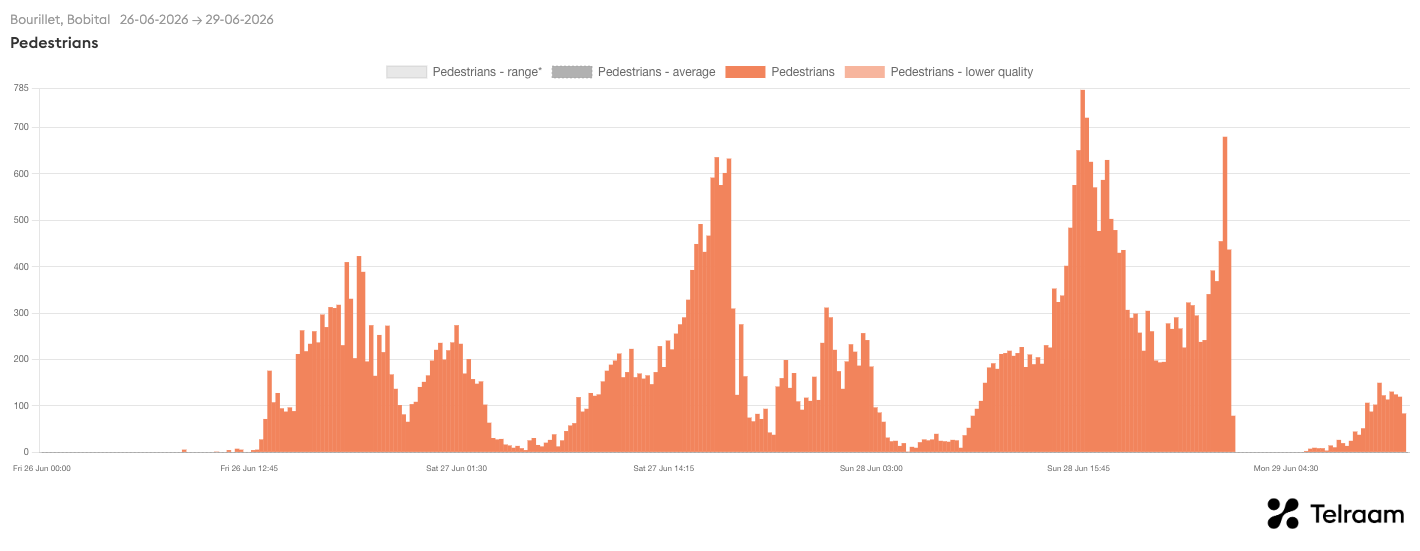
The data from Bobital already illustrates why the three-ring approach works, ring by ring.
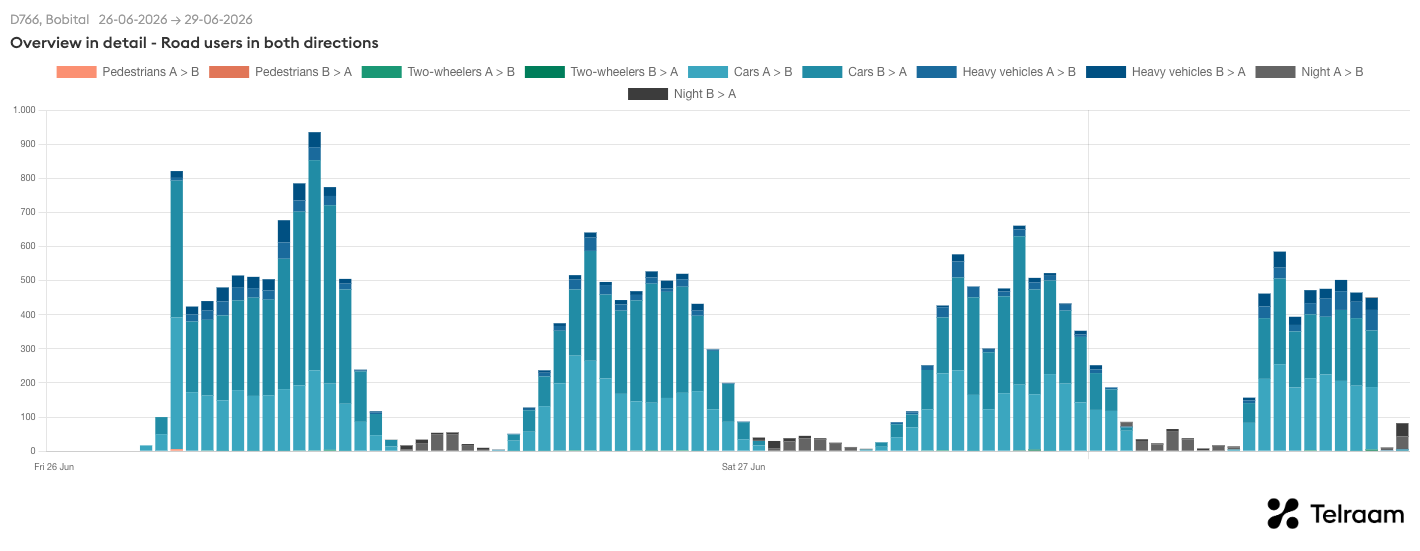
Furthest out, on the D766 departmental road approaching the festival, the picture is almost entirely motorized: wave after wave of car traffic, with heavy vehicles mixed in, building through each day from Friday onward and peaking at over 900 road users in a single interval. This is exactly the view Oktoway's anticipation unit needed at the outer ring, the arrival pressure forming while it is still 15-20 minutes away from the gates, with each day's wave visible early enough to act on.
What our client says
"We chose Telraam for how easy it is to install and how reliable the hardware is. The minute-by-minute data frequency is essential for us within our anticipation unit. On top of that, the multimodal detection lets us plan ahead: it gives us the ability to track vehicle flows in both directions, as well as cyclists and pedestrians at control points, and to manage parking capacity."
Tony Perrin and Jérome de Rougemont, Oktoway SAS
Want to know more about this project?
Feel to free to get in touch.